
Our voice · Published piece
Secularism and feminism, some ideas to challenge us
SOME IDEAS TO CHALLENGE OURSELVES
Miriam Suárez Vargas
For many years, after getting to know and fight with other activists, I declared myself a feminist. I understood feminism as that relationship between political thought and action against systems of domination and oppression, and, in that respect, the women of Santa Cruz and the world have much to reveal, after the invisibility and denial that religions and the colonial State imposed on women.
In this sense, speaking of a secular state, beyond the separation of churches from the state, is for all women a condition for liberation, the same as we could say of the plurinational state, which breaks with the conception of the nation-state: monoethnic, unitary and homogeneous, which historically denied the existence of the plural and different that inhabited and inhabits these lands for millennia, I am referring to the indigenous peoples and original nations.
Both the colonial state and the nation-state forged a society that denied what it is and what it contains. Both states responded to a hierarchical, elitist, and racist model of society, but also to a way of being whose measure was (is) man, and not just any man, but the white Westerner, possessor of goods with the status of power and command, that is, in a word, a patriarch! For this reason, the Plurinational State constitutes a profound historical break of an epistemic nature with that conception of the State.
Declaring oneself a feminist is a challenge; declaring oneself secular is much more so. It implies attacking the very core upon which the patriarchal state rests. If the plurinational state invites us to recognize the pluriverse, the secular state invites us to think beyond the foundational myth of Western thought and calls upon us to dismantle it. That is to say, it compels us to journey back in time, into the colonial historical memory, to question the biblical content of Genesis that condemns women to live and give birth in pain, and positions them as an extension of man's rib. This narrative legitimizes gender-based violence and inaugurates the paradigm of domination, not only over women, but also over nature.
Therefore, proposing or defending the Secular State is equivalent to saying, from a feminist perspective, that women are not anyone's rib; we reject that narrative that condemns us to live under the wing of the patriarch, but that also condemns nature (today we would say Pachamama) to be the subject of patriarchal domination.
In light of these considerations, and clarifying the framework of these two ideas—secularism and plurinationalism—I reaffirm that a secular state, beyond the separation of church and state, represents the displacement of an established power from the state sphere, in this case, ecclesiastical power, which reinforces, reproduces, and perpetuates the patriarchal system, affecting people's lives and condemning them to live within a framework of prohibitions, particularly women, subjecting us to a system of domination and subordination. For this reason, defending a secular state implies overcoming patriarchal ideology and the privileges of the churches.
While the colonial state reproduced the dominations inherited from the times of the Spanish colony, that time of conquests and subjugations instituted under the assumption of a Western superiority and annulment (denying) of the civilizations pre-existing to the colony, turning them into savages and emptying them of all their humanity to justify the colonizing project, a system that appropriated the work of others, carried out strict control of the female body and stripped the social wealth of the communal sphere by exploiting goods, resources and bodies of those communities pre-existing to its arrival.
By controlling women's bodies, the colonial state turned them into objects, attempting to nullify and silence their right to be subjects of their own history. However, although there are few texts that narrate the participation of women in the struggles of colonial resistance, these demonstrate that there were always women who opposed domination, and, beyond that power relationship, opposed the universalism of the West as the only way of life in society.
What I want to share with you is that fatal encounter between the church and the colonial state, fatal for everyone, but particularly for women who were prey to the cruelty, persecution and torture that, in the name of God and the Holy Bible, was inflicted on their bodies and their practices by a church that had equal or more power than the state itself.
I maintain that both systems—state and church—reinforced each other, needing each other to keep people fearful and disciplined, defining them by what they considered good and evil, thus maintaining them under forms of domination in the name of faith. If it's a matter of faith, who can question it?
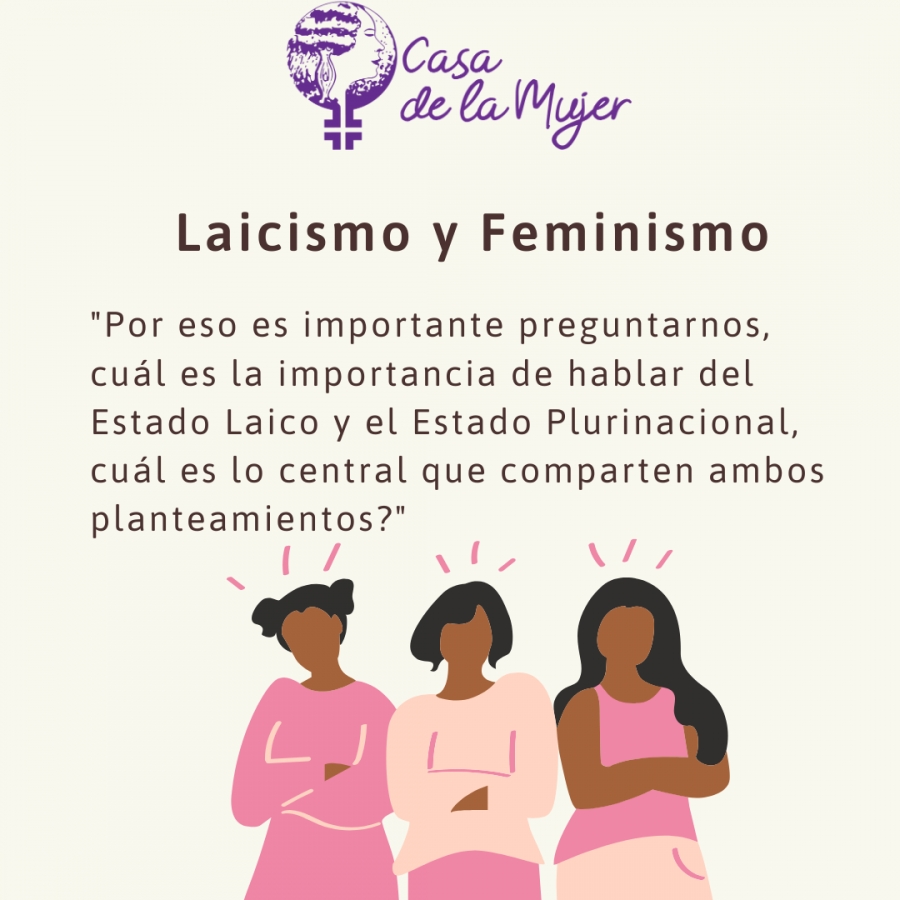
That is why it is important to ask ourselves, what is the importance of talking about the Secular State and the Plurinational State, what is the central thing that both approaches share?
Both break with the paradigm of patriarchal domination symbolically justified by the church. The church condemns women to the dominion of men and nature, to the domination of the Western colonial modern society project, while the Plurinational State breaks with colonial domination based on differences, subjugating the other, appropriating their labor, their wealth, their bodies.
For us feminists, the secular state and the plurinational state are important because they contribute to broadening the political horizon with a view to the emancipation of all resistance movements, struggles, and above all, women.
It falls to us—women, lesbians, trans people, gay men, Indigenous people, and other movements committed to liberating transformations—to harness all our efforts to become the constituent forces of a society with social, gender, and environmental justice, the reason that inspires and motivates our dreams and anxieties. The current national and global situation, characterized by a profound multidimensional crisis, particularly a climate and civilizational one, must call us to unite and form alliances around the defense of the secular and plurinational state as the structuring principles of a new dawn.
Our actions must be aimed at strengthening a new power that overthrows Western hegemonic thinking, that questions and deconstructs its modernizing project and its development models.
We need a secular state as the condition that allows freedom of conscience to think and believe autonomously, without pressure or tutelage of any kind. We need a plurinational state to recognize all subjects in order to dismantle this modern colonial capitalist system that imposes a single way of thinking and, therefore, a homogenizing understanding and organization of the world. We need both, a secular and a plurinational state, to place the demasculinization of the world and the emancipation of all those silenced, including Mother Earth who sustains our lives, within a liberating perspective.
Finally, secularism and feminism reinforce each other, and the demand for equality for all people and nations is an emancipatory aspiration that can no longer be delayed.
Casa de la Mujer
Psychological, legal, medical and social support from a feminist perspective in Santa Cruz de la Sierra.