
Our voice · Published piece
The family food basket doesn't even cover my son's medicine.
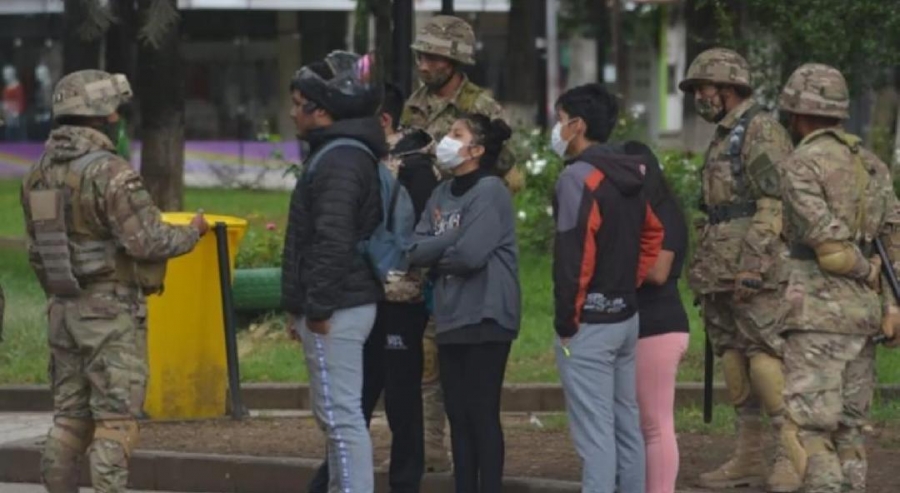
While the quarantine remains in place in the country, the economic needs of the population are increasing, since many families not only live on income generated from day to day, but in addition to that they must also pay rent for their homes, others must cover medical expenses for family members with some physical deficiency.
This is the case of Dora (fictitious name), a mother of 3 children, one of whom requires permanent (daily) medication, but the prohibitions and militarized restrictions imposed by the government during quarantine do not allow her to move around easily to work and obtain sufficient resources to cover those expenses.
This mother, with tears in her eyes, told us verbatim, “I have a child who takes medication and I spend at least Bs. 20 a day on his medicine, and what the family food basket is giving me isn't enough, not even for my son's medicine,” she lamented, her voice breaking, while clarifying that she has not yet received any bonus, because when she went to a financial institution they told her there were no funds.
Aside from the economic hardship Dora faces daily during this quarantine, she also has to pay her rent, which is now overdue for a month and she doesn't have the resources to cover it. She tells us that the owners of the house where she lives "have already asked me if I'm going to stay or move out, and I have no way to pay my rent."
Another similar case is that of Jenny (fictitious name), who also lives off the resources she generates daily working in a market. She is a single mother, and tells us that she feels powerless seeing her young children and not even being able to satisfy their right to food.
“What will become of those of us who don’t have any money? Those of us who work in the market earn daily and don’t have a single peso to eat now (…) we are single mothers, our children don’t know where we get the money and now with this quarantine there is no work, and we don’t know what to do,” she exclaimed.
Jenny understands that it's about taking care of her health, but she also says, "My son hasn't eaten for days because of this quarantine, and I'm tired of it and I wish this situation would end," she says worriedly, since her family depends on her.
Undoubtedly, the needs of the population are not the same, and some sectors are more vulnerable than others; therefore, their situation of inequality is much deeper. Perhaps policies should be more focused on addressing and reducing these gaps, which are much more pronounced in women, who are forced to bear a very heavy burden alone.
RADIO ALTERNATIVA 103.0 FM SANTA CRUZ- BOLIVIA
Casa de la Mujer
Psychological, legal, medical and social support from a feminist perspective in Santa Cruz de la Sierra.