
Our voice · Published piece
The poor frighten
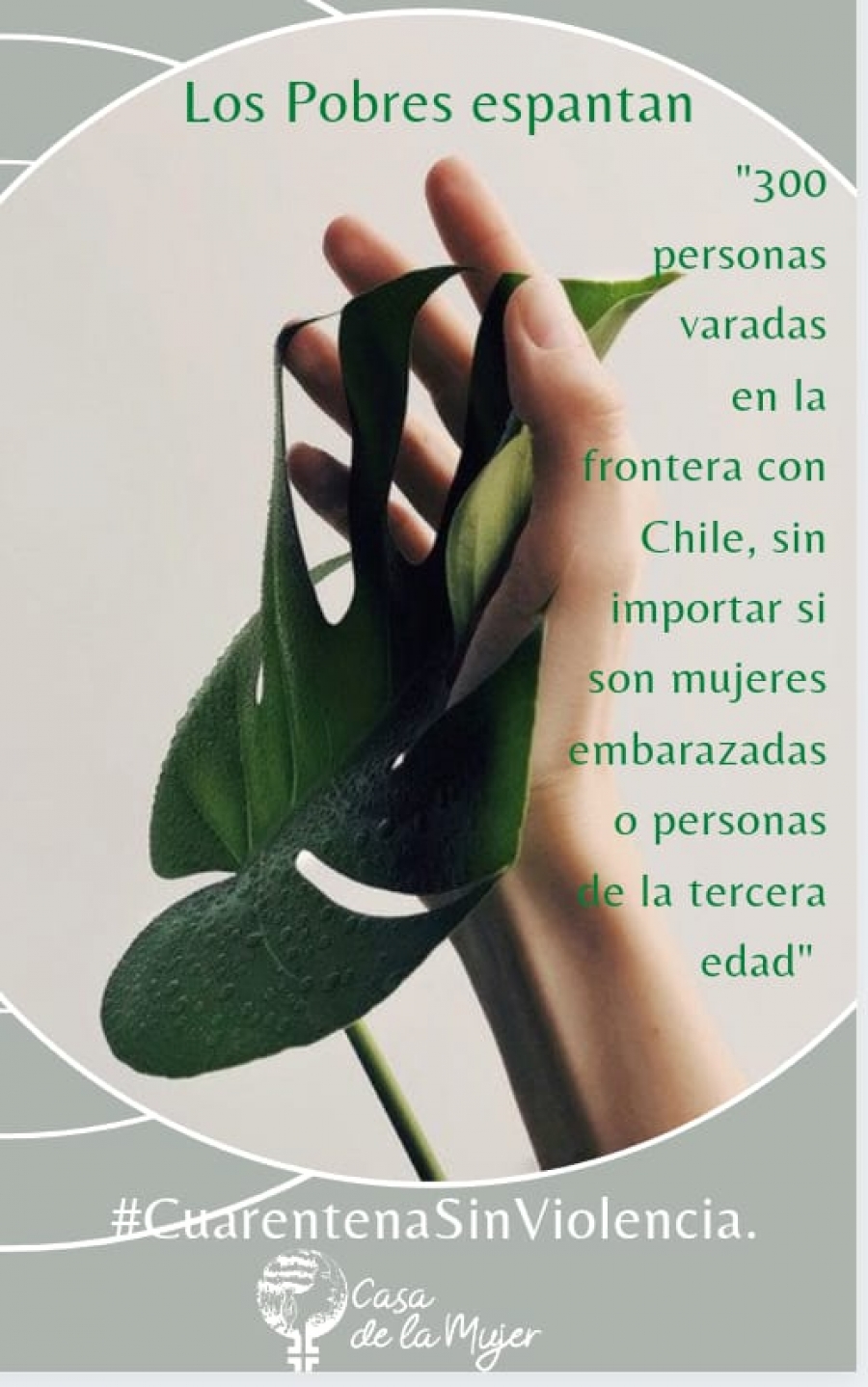
The government never misses an opportunity to demonstrate its contempt for the poor. Its methods of intimidation, the abuse of power by uniformed personnel, and the constant threats of imprisonment for anyone who dares to disobey, confirm its inability to govern with respect for all the existing diversities in this secular and plurinational state, where it is impossible to hide the different social classes, the indigenous communities and peoples, the inequalities between genders, the denial of sexual diversity—in short, all the diversity that inhabits us and that the interim government and its cronies deny because they only see the country through their own biases.
Drastically decreeing the closure of the national territory, leaving a group of 300 people stranded at the border with Chile, regardless of whether they are pregnant women, elderly people, or children at the country's gates, represents a violation of Universal Rights, the Global Compact on the Rights of Migrants, and the Bolivian Constitution. The mandate that "no one enters and no one leaves" crumbles when international flights are organized to evacuate tourists of different nationalities—"humanitarian flights"—or when Ecojet recently brought in 36 Bolivians on board, in another "so-called humanitarian flight," while the poor, who cannot afford the blessed humanitarian flight, are abandoned.
Finally, to justify their rudeness, the interim government accuses the Bolivians stranded at the border of being supporters of the MAS party. Being poor, unfortunately, is a crime in this country and in many parts of the world, but since when is having an ideology a crime?
The State cannot abandon people to the elements, without food, without minimum conditions to keep them safe from the coronavirus; it cannot deny its role as guarantor of the rights of Bolivians. The people stranded at the border are not asking for favors, they are simply reminding the State to do what is required, to ensure the full exercise of their rights, and for the specific case, see the CPE, art. 21, paragraph 7 and art. 22.
No one can turn a blind eye to the plight of those stranded at the country's borders. It's the same plight and anguish experienced by women who sleep by their front doors, unable to enter because "someone" has decided otherwise, violating their rights and condemning them to suffer any kind of abuse or humiliation. Will we remain indifferent to these crimes? Can we reverse this situation?
The statements and attitudes of the authorities are typical of a dictatorship that is not ashamed to demonstrate its repressive methods with the clear intention of paralyzing all social movements that question its ways of building hegemony and seizing political and economic power in this State that we claim as our Secular and Plurinational State.
Women's Center
Casa de la Mujer
Psychological, legal, medical and social support from a feminist perspective in Santa Cruz de la Sierra.